How to forget a Wi-Fi network on Mac, iPhone, and iPad
Posted on
by
Doris Muthuri

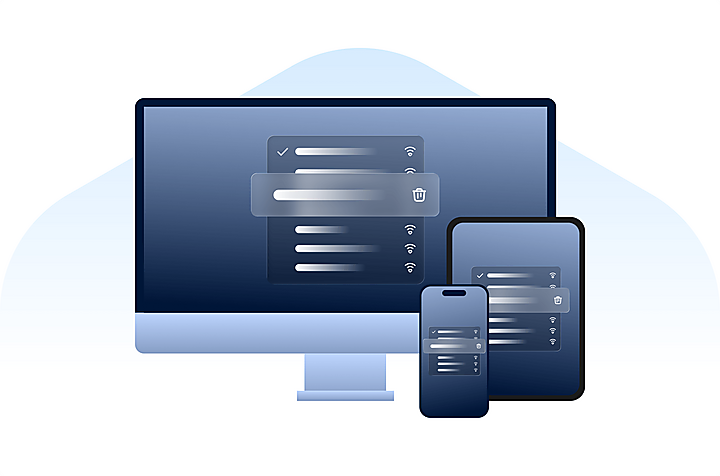
Joining a Wi-Fi network usually takes only a moment, but your Mac remembers that connection long after you stop using it. The network may also appear on your other Apple devices if your Wi-Fi passwords sync through iCloud Keychain.
This guide explains how to forget a network on Mac, including connected and out-of-range networks. You’ll also learn how to remove networks from an iPhone or iPad and stop unwanted automatic connections.
What happens when you forget a Wi-Fi network?
According to Apple’s guidance on forgetting Wi-Fi networks, the change also applies to other devices signed in to the same Apple Account when iCloud Keychain is enabled. Forgetting a network doesn’t delete it from the router, change its password for other users, block it from appearing, or reset your other network settings.
Should you forget the network or turn off Auto-Join?
The right option depends on whether you want your device to retain the network’s password.
| What you want to do | Best option | What happens |
| Forget one network and its password (Mac, iPhone, iPad) | Forget the network | Your device disconnects and needs the password to reconnect |
| Stop a network reconnecting but keep the password (Mac, iPhone, iPad) | Turn off Auto-Join | The network stays saved; you join it manually when you want |
| Reset saved network settings (iPhone and iPad only) | Reset Network Settings | Clears saved Wi-Fi networks and passwords, plus cellular and manually added VPN settings; managed settings can remain |
| Forget a school or work network (Mac, iPhone, iPad) | Ask the network administrator | A management profile can block removal; the Forget option may be grayed out or missing |
Reset Network Settings is the broadest option, so use it only after more targeted troubleshooting hasn’t worked. It removes saved Wi-Fi networks and passwords along with other network settings, though managed settings can remain.
How to forget a Wi-Fi network on a Mac
You can remove the network you’re currently using in Wi-Fi settings or open the Known Networks list to find any network your Mac has saved. These options work the same way on a MacBook Air, MacBook Pro, iMac, Mac mini, Mac Studio, and Mac Pro.
If you may need the network again, make sure you know its current password before removing it.
These steps apply to macOS Ventura 13 and later. Earlier versions use System Preferences and may show different labels.
Forget the connected network in Wi-Fi settings
Use this method when your Mac is connected to the network you want to forget:
- Click the Wi-Fi icon on the right side of the menu bar, and select Wi-Fi Settings. You can also open System Settings from the Apple menu, then click Wi-Fi.
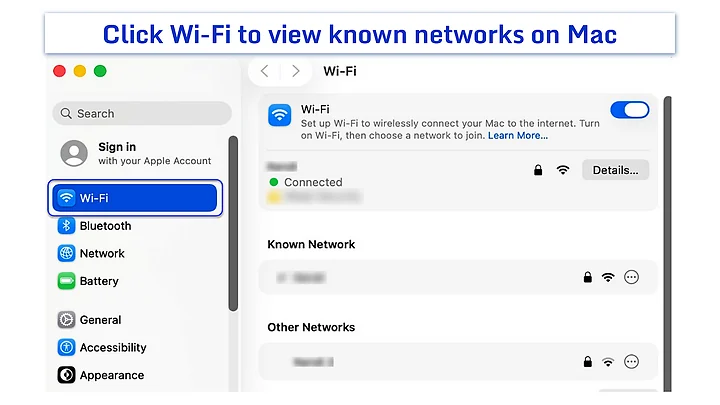
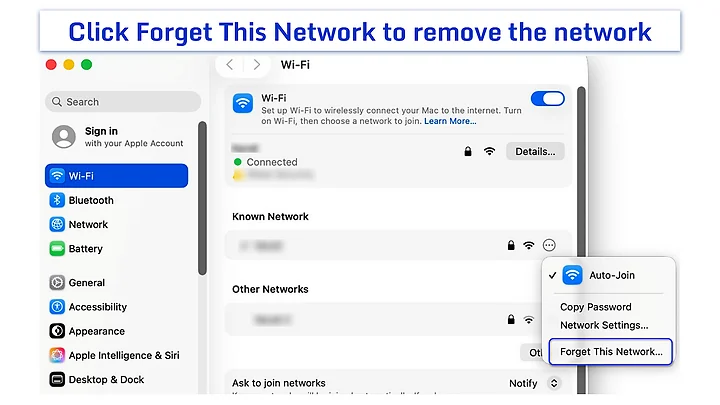
- Click Details beside the connected network, then click Forget This Network.
- Click Forget to confirm.
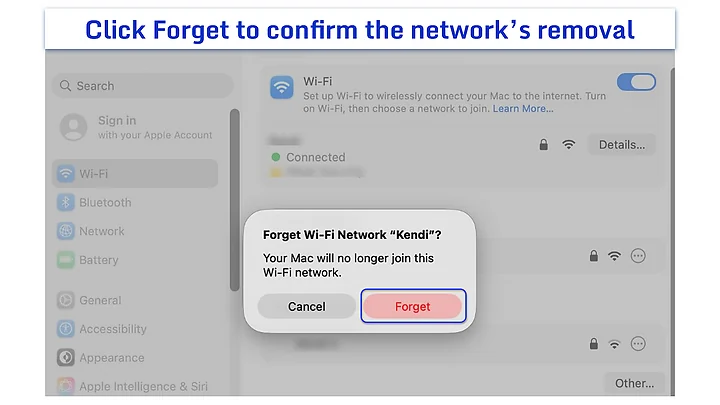
Your Mac will disconnect immediately. If the Wi-Fi icon isn’t in the menu bar, open Control Center, click Wi-Fi, and select Wi-Fi Settings.
Remove any saved network through System Settings
Use this method to find and remove a saved network even when it isn’t nearby:
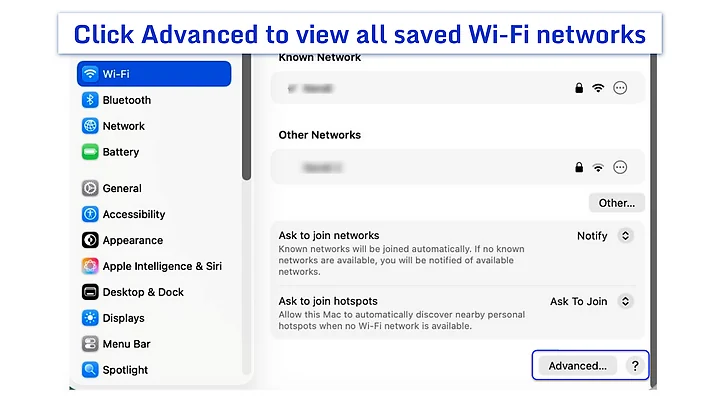
- Open the Apple menu and select System Settings, then click Wi-Fi in the sidebar. Scroll down and click Advanced.
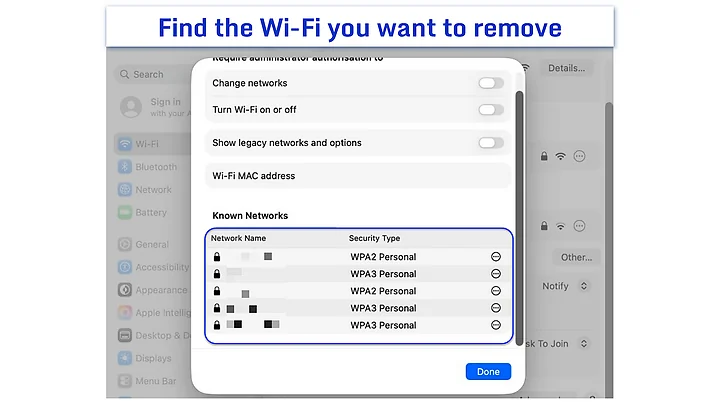
- Find the network under Known Networks.
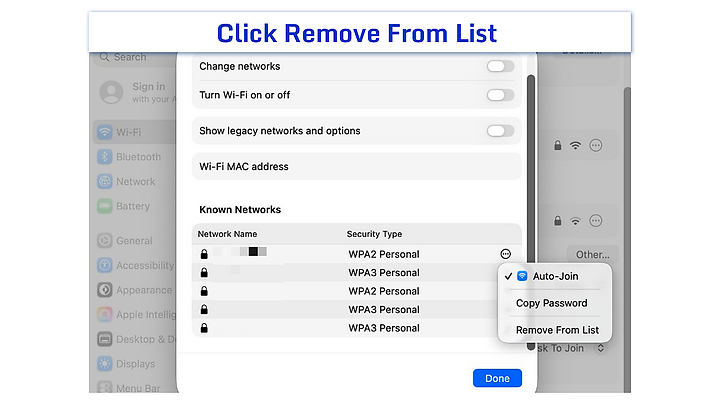
- Click the More button (…) next to the network and select Remove From List.
- Click Forget to confirm.
You can repeat these steps to remove other saved networks.
How to stop your Mac from automatically joining a network
Turn off Auto-Join when you want your Mac to retain the saved password but connect only when you choose the network manually.
- Open the Apple menu, choose System Settings, then click Wi-Fi in the sidebar.
- Scroll to the bottom of the Wi-Fi settings and click Advanced to view every network your Mac remembers, including networks that aren’t currently nearby.
- Find the network you want to manage under Known Networks and check that you’ve selected the correct network name.
- Click the More button (…) beside the network to open its available options.
- If Auto-Join has a checkmark, click it once to remove the checkmark and disable automatic connections. If there’s no checkmark, Auto-Join is already off.
Turning off Auto-Join doesn’t immediately disconnect your Mac if it’s currently using the network. Once you disconnect or move out of range, your Mac won’t reconnect automatically, but the network and password will remain saved. You can still select it from the Wi-Fi menu whenever you want to connect.
For the network you’re currently using, you can also open System Settings > Wi-Fi, click Details beside its name, and turn off Automatically join this network. If your Mac continues choosing an unwanted connection, learn how to prevent it from connecting to the wrong Wi-Fi network.
How to delete a saved Wi-Fi password with the Passwords app
On macOS Sequoia 15 and later, you can view and delete saved Wi-Fi credentials through Apple’s Passwords app. Use this method if an old Wi-Fi password remains after you remove the network through System Settings.
- Open the Passwords app on your Mac and unlock it with Touch ID or your login password.
- Click Wi-Fi in the sidebar to view your saved networks.
- Find and select the Wi-Fi network whose password you want to delete.
- Click Edit, then click Delete Password, then confirm the deletion.
Deleting the password removes the saved credential, but the network may still appear under Known Networks. To forget it completely, open System Settings > Wi-Fi > Advanced and remove it from the list.
How to delete a saved Wi-Fi password through Keychain Access
Keychain Access is now a legacy option on current macOS versions. Use it as an advanced fallback if the Wi-Fi credential still appears after you remove the network through System Settings and delete its password from the Passwords app. You can also use it on macOS Ventura or Sonoma, which don’t include the Passwords app.
- Press Command-Space to open Spotlight, type Keychain Access, and press Return.
- If you don’t see the keychain list, select Window > Keychain Viewer or press Command-1.
- Select All Keychains if available. Otherwise, search the login, Local Items or iCloud, and System keychains separately for matching entries.
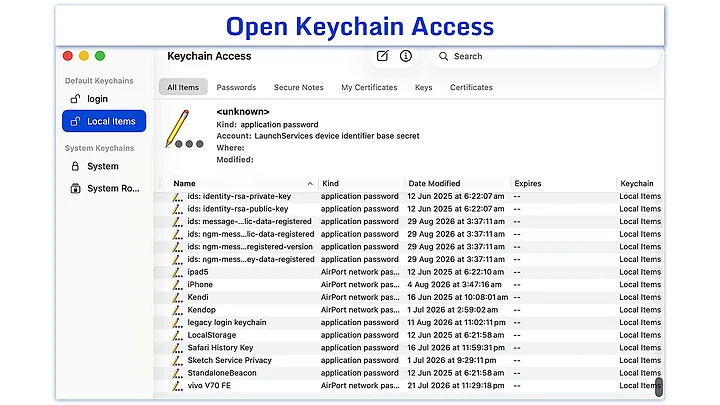
- Type the Wi-Fi network’s exact name into the search box. If that produces no result, search for AirPort to display stored wireless credentials. Find the entry whose Name matches the network and whose Kind is AirPort network password. Don’t delete an AirPort base station password or AirPort Disk password, as these are different credentials.
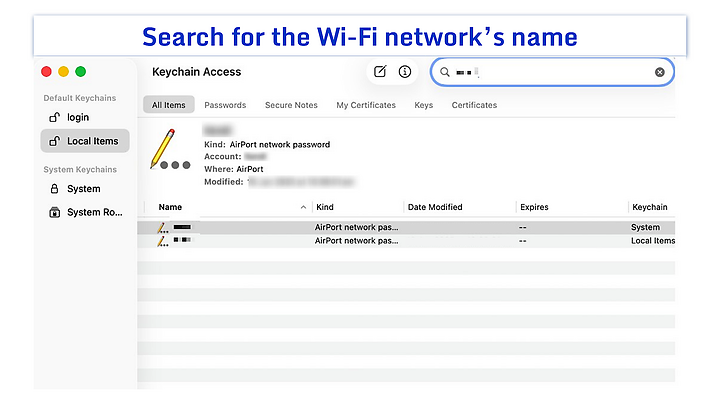
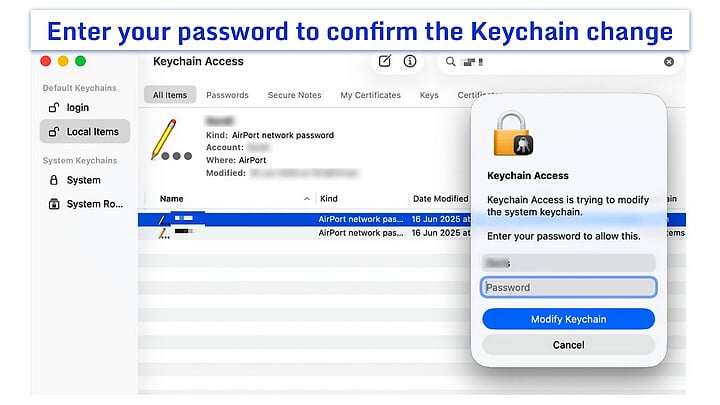
- Select the correct entry, press Delete, and confirm that you want to remove it. Enter your Mac password or use Touch ID if prompted.
- Return to System Settings > Wi-Fi > Advanced and check the Known Networks list. If the network still appears, click the More button (…), select Remove From List, and confirm.
How to forget a Wi-Fi network on an iPhone or iPad
You can forget a visible network from its information page or open the saved network list to remove one that’s out of range. The steps are nearly identical on iPhone and iPad and follow Apple’s current instructions for managing known Wi-Fi networks.
Forget a network that’s currently in range
Use this method when the network appears in your Wi-Fi settings:
- Open the Settings app and tap Wi-Fi.
- Find the network you want to remove and tap the More Info button (ⓘ) beside its name.
- Tap Forget This Network and then tap Forget again to confirm.
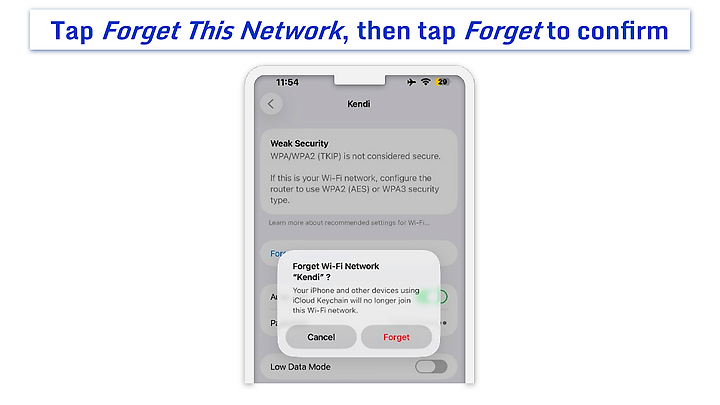
If you’re connected to the network, your iPhone or iPad will disconnect immediately.
To keep the network saved but stop your device reconnecting to it, turn off Auto-Join on that same More Info screen instead of tapping Forget This Network.
Remove a saved network that’s out of range
You don’t need to be near a saved network to remove it from your iPhone or iPad:
- Open Settings and tap Wi-Fi.
- Tap Edit in the upper-right corner to view the networks saved on your device.
- Authenticate with Face ID, Touch ID, or your device passcode if prompted.
- Find the network under Known Networks and tap the More Info button (ⓘ) beside it.
- Tap Forget This Network, then tap Forget to confirm.
Reset all network settings as a last resort
Reset Network Settings clears saved Wi-Fi networks and passwords rather than one specific connection. It also resets cellular settings and removes VPN settings that weren’t installed by a configuration profile or device management. Managed network settings can remain. Make sure you have the Wi-Fi passwords and VPN setup details you’ll need before continuing. Use this option only when removing individual networks hasn’t worked.
- Open Settings and tap General.
- Scroll down and tap Transfer or Reset iPhone or Transfer or Reset iPad.
- Tap Reset.
- Select Reset Network Settings.
- Enter your device passcode and confirm the reset.
If you’re preparing for a trip, review these additional steps for keeping your Mac or iPhone secure while traveling.
Why does a Wi-Fi network keep reappearing after you delete it?
First, check where the network appears. If it’s listed under Other Networks or available nearby networks, your device has only detected its signal. This doesn’t mean the network is still saved. It has returned as a saved network only if it appears under Known Networks or your device joins it automatically.
If a network remains saved after you forget it, check whether iCloud Keychain has synced the change and whether a configuration profile manages the network.
The network is syncing through iCloud Keychain
iCloud Passwords & Keychain keeps Wi-Fi information updated across devices signed in to the same Apple Account. Apple states that forgetting a network should sync to your other approved devices. If one device still shows the network, make sure it’s connected to the internet and that iCloud Passwords & Keychain is syncing.
Try these steps:
- Connect your Mac, iPhone, and iPad to the internet so they can receive the latest iCloud changes.
- Check that each device is signed in to the same Apple Account.
- On a Mac, open System Settings > [your name] > iCloud. Click Passwords in macOS Sequoia or later, or Passwords & Keychain in macOS Sonoma or earlier, then confirm that Sync this Mac is on.
- On an iPhone or iPad, open Settings > [your name] > iCloud. Tap Passwords in iOS or iPadOS 18 and later, or Passwords & Keychain in version 17 or earlier, then confirm that Sync this iPhone or Sync this iPad is on.
- Remove the network from every device where it remains under Known Networks, then allow a few minutes for the change to sync.
- Restart any device that still shows the network as saved and check its Known Networks list again.
If the network persists on your Mac, open the Passwords app and check the Wi-Fi section for a leftover entry. If one remains, remove it there, or check Keychain Access for a duplicate AirPort network password entry.
A configuration profile manages the network
Schools, employers, and other organizations can install Wi-Fi settings through a configuration profile or mobile device management. A managed network may return after deletion, or the options to forget it and turn off Auto-Join may be unavailable.
Don’t remove a school or work profile without approval from the organization that manages the device. If the Remove option is unavailable, Apple advises contacting the administrator who provided the profile.
Removing a profile deletes all of its settings and information, including any account information it installed. Review what the profile controls before removing it.
To check your Mac:
- Open System Settings.
- Select General and click Device Management.
- Double-click a profile to view the settings it controls and check whether it includes the Wi-Fi network.
- If you installed the profile yourself and no longer need any of its settings, select it and click the Remove button (–).
To check an iPhone or iPad, open Settings > General > VPN & Device Management and select the relevant profile. Removing a profile also removes the settings, apps, and data associated with it, not just the Wi-Fi network.
Why should you remove old saved Wi-Fi networks?
You don’t need to delete every network you’ve ever joined, but removing connections you no longer use can make your devices safer and easier to manage.
- Prevent unwanted automatic connections: Apple devices can automatically join networks they recognize as known. Removing old hotel, airport, café, or office networks keeps your device from selecting them later based on factors such as previous use, security, and signal strength, which Apple explains in its Wi-Fi Auto-Join criteria.
- Reduce the risk of connecting to an impersonated hotspot: Someone can create a network with the same name as a legitimate public network. Under certain conditions, your device may mistake it for a saved connection, which could expose you to a man-in-the-middle attack. Removing unused public networks reduces this opportunity.
- Clear outdated connection details: Forgetting and rejoining a network gives your device a fresh connection using the new details after its password, security type, or router settings change.
- Make troubleshooting easier: A shorter Known Networks list makes it easier to identify duplicate names, outdated credentials, and networks your device shouldn’t join.
Removing saved networks doesn’t improve Wi-Fi speed or prevent nearby networks from appearing. Focus on old public networks, networks you no longer trust, and connections that cause problems. The VPN included with Intego ONE Complete encrypts traffic routed through its active connection between your device and the VPN server. It doesn’t stop your device from joining the wrong network, so managing saved connections still matters.
Keep only the Wi-Fi networks you trust
Forgetting networks you no longer use keeps your Known Networks list manageable and prevents unwanted automatic connections. If you still use a network occasionally, turn off Auto-Join instead so your device retains its password without connecting automatically.
If a deleted network remains saved, check whether iCloud Keychain has synced the change or a configuration profile manages the network before resetting all network settings.
How we checked this guide
We followed these steps on a Mac running macOS 27 and an iPhone running iOS 27. On the Mac, we forgot a connected network in Wi-Fi settings, removed a saved network from the Known Networks list, and deleted an AirPort network password in Keychain Access. On the iPhone, we forgot a network with Forget This Network. We checked the out-of-range iPhone steps, iCloud syncing, and configuration profile guidance against Apple’s support documentation. Last checked: 30 September 2026. Menus and available options may differ by device or software version.
Frequently asked questions
How do I stop my Mac from automatically joining a specific Wi-Fi network without deleting it?
Turn off Auto-Join for that network. Go to System Settings > Wi-Fi > Advanced, click the More button (…) beside the network, and deselect Auto-Join. Your Mac will keep the saved password but connect only when you select the network manually.
Can I remove a Wi-Fi network on my Mac without opening System Settings?
Yes. Advanced users can remove a known Wi-Fi network through Terminal, but the standard method uses System Settings. Keychain Access only deletes the saved credential and may leave the network in the Known Networks list.
Why do my Mac and iPhone show different saved Wi-Fi networks?
Your Mac and iPhone may be showing different lists. The main Wi-Fi screen often shows nearby networks, while Wi-Fi > Advanced on Mac and Wi-Fi > Edit on iPhone show all saved networks.
If those lists still differ, check that both devices use the same Apple Account and have iCloud Passwords & Keychain syncing enabled. Sync delays, offline devices, and networks installed through configuration profiles can also cause differences.
Can I remove a school or work Wi-Fi network from my Mac?
Yes, if you joined the network manually, you can remove it through System Settings > Wi-Fi > Advanced. If a school or employer installed it through a configuration profile or device-management service, the removal option may be unavailable. Contact the organization’s administrator instead of removing the management profile yourself.
Does forgetting a Wi-Fi network delete its password?
Yes. Forgetting a Wi-Fi network removes its saved password from your device. If iCloud Keychain is enabled, the change also syncs to your other devices using the same Apple Account. You’ll need to enter the password again to reconnect.
Can I reconnect to a Wi-Fi network after forgetting it?
Yes. Select the network from the Wi-Fi list and enter its current password to reconnect. Your device will save the network again and may automatically join it in the future unless you turn off Auto-Join.


